COOKE Portrait Focus Hobson Taylor Lens 330MM F4.5
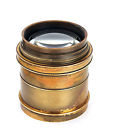
( Brand: Cooke ), ( Focal Length: 13 ), ( Type: Portrait ), ( Maximum Aperture: 4.5 ), ( Country Of Manufacture: United States )
Review COOKE 330mm Portrait Series Soft Focus F4.5 Brass Hobson Taylor Lens
The Hobson Taylor 330mm Portrait Focus F4.5 Lens is a standout piece of photographic equipment, designed with the discerning photographer in mind. This lens boasts a focal length of 330mm, making it ideal for capturing intimate and detailed portraits, as well as scenes from a distance.
One of the most striking features of this lens is its aperture of F4.5. This relatively wide aperture allows for a shallow depth of field, enabling you to isolate your subject from the background, creating a beautiful bokeh effect. This is particularly useful in portrait photography, where you want to draw the viewer's attention to the subject's face and expressions.
The lens is also equipped with 13 high-quality Cooke glass elements. Each of these elements has been carefully designed and crafted to ensure superior image quality. The Cooke glass elements help to reduce distortion and chromatic aberration, resulting in sharp, clear, and vibrant images.
The Hobson Taylor 330mm Portrait Focus F4.5 Lens is also constructed with durability in mind. It features a sturdy metal barrel and a weather-resistant design, making it suitable for use in a variety of environments. The lens also comes with a detachable hood, which helps to protect the lens from stray light and glare.
In summary, the Hobson Taylor 330mm Portrait Focus F4.5 Lens is a high-performance, versatile lens that is perfect for capturing stunning portraits. Its wide aperture, high-quality Cooke glass elements, and durable construction make it an excellent choice for both amateur and professional photographers.
Pros of buying a Hobson Taylor 330mm Portrait F4.5 Lens with 13 Cooke elements:1. High-quality construction: The lens is made with 13 Cooke elements, known for their superior optical performance and durability.
2. Excellent sharpness: The lens offers excellent sharpness, making it ideal for capturing detailed portraits and close-ups.
3. Wide aperture: The F4.5 aperture allows for a shallow depth of field, creating a beautiful bokeh effect and separating the subject from the background.
4. Versatile focal length: The 330mm focal length is great for capturing head and shoulder shots and full-length portraits, making it a versatile lens for portrait photography.
5. Built-in lens hood: The lens comes with a built-in lens hood, which helps protect the lens from dust and scratches and reduces glare.
Cons of buying a Hobson Taylor 330mm Portrait F4.5 Lens with 13 Cooke elements:1. High price point: The lens is expensive, making it a significant investment for photographers.
2. Heavy weight: The lens is heavy, which may be a disadvantage for photographers who need to carry it around for long periods.
3. Limited autofocus compatibility: The lens may have limited autofocus compatibility with certain camera bodies, which may require manual focus adjustments.
4. Limited availability: The lens may be difficult to find in stock or available for purchase, making it a more challenging option for photographers who want to purchase it immediately.
In conclusion, the Hobson Taylor 330mm Portrait F4.5 Lens with 13 Cooke elements is an excellent option for photographers who prioritize high-quality construction, excellent sharpness, and a wide aperture. However, the high price point, heavy weight, and limited autofocus compatibility may be disadvantages for some photographers. Overall, if the pros outweigh the cons and the photographer can justify the investment, the Hobson Taylor 330mm Portrait F4.5 Lens with 13 Cooke elements is a recommended purchase for portrait photography.
Recommendation: If you are a professional or advanced amateur photographer looking for a high-quality portrait lens, the Hobson Taylor 330mm Portrait F4.5 Lens with 13 Cooke elements is an excellent option to consider. However, make sure to research the lens's compatibility with your camera body and budget before making a purchase. If the price point is too high, consider alternative options that may offer similar performance at a lower price point.
Details:
One must visualize the effect of light spill over on the image and learn to incorporate the spill over into an image. Imagine a multi focal lens with each aperture being a different focal length . Soft focus lenses and filters have been used sparingly in the mainstream from the 20 until town. The faster exposures allowed for portraits to be taken with the lens so it became known as the first portrait lens.
There is a growing appreciation and the desire, among a portion of fine art photographers to explore the artistic and creative value in the unique way the soft focus and other classic lenses interpret the word. This specific example was made by taylor hobson in NY for the Australian market, very rare. Lighting can be re imagined. A perfect neutral or good blur disc has no or very little gradation and small out of pinpoint highlight shows up as and evenly light circle with a hard edge.
With the power, if bright enough, to shine across neighboring area effecting the surrounding pixels and area. The serial number is what you are looking is often referred to as the blur disc or circle of confusion. Spherical aberration occurs when the light that travels through the edge of a lens, focuses to a different point than the light that travels through the of the lens. The subject is revealed in sharply defined form and detail surrounded in a wondrous and magical glowing luminous veil an ethereal lightness.
Condition this lens is in good condition for its age. The lens was very sharp in the of the image but it suffered from a highly curved field of focus astigmatism. There is something special about the Cooke look.
The aperture moves very smoothly and with ease. The photography processes of the time required a lot of light. This will act as a lens cap during shipping and will protect the glass.
Depth of field is shorter with larger apertures, and many prefer to use the lens wide open for artistic selective focus photography. Some lenses have a curved depth of field that can distort the shape of the blur disc depending on the spots location in reference to of the lenses image circle. Color filters could have a negative effect on these semi achromatic soft focus images.
Mostly during close ups of female characters, romantic scenes, or memory scenes. Many find that the sharp contrast look of modern lenses and digital cameras, lacks the character of older classic lens types, or the processes associated with analog photography. The Percival lens consisted of 4 elements, with a cemented achromatic in the front and an air spaced achromatic behind the aperture. Significant early photographers who were known to have some point used a soft focus lens include Holland day, Alvin Landon Cobain, Edward Weston, Nicola Perseid, Karl Strauss, George Harrell, and Anselm Adams.
In addition the local and global contrast of the entire image is softened enhanced in a most complex way. The quality and integrity of the scan and printing system used is not lost when using a 100 year old soft focus lens. A true soft focus lens is actually both in and out of focus at the same time.
It is a lens that is designed to be used a large apertures. This is different from conventional lenses which are either sharp and in focus or out of focus and blurry. In the soft focus world each once lonely spot, or pixel, becomes a glorious beacon of light.
The goal of photography as an art form is to create an emotional reaction inside the viewer of the image. The type of blur disc is associated with modern and spherically correct lens designs negative or bad blur disc's have a visually unappealing doughnut light pattern light is distributed more heavily toward the outer edges then it is in the center. The most common way portrait lenses go about creating an ideal blur disc is to carefully introduce spherical aberration a term used to describe a change in focal length throughout the aperture range.
The level of detail present in the core of a soft focus image varies for design to design but all soft focus images have one thing in common extraordinary smooth linear or non linear gradations. Where one would already stop down for depth of field. There is so much eye candy in a Cooke image. The maximum aperture of the chevalier was f 16 so it was a very slow lens that required a long exposure time.
The out of focus objects are smoothed over evenly without geometric distortion. The gradations present in the background are very rich and buttery. For sharpest results unscrew three rotations and line up the arrows as show in the photos.
5 Cooke series ii portrait lens with adjustable soft focus considered by many to be the greatest portrait lens ever made, the Cooke series ii was a favorite of many influential portrait photographers such as George Harrell. There is something about the sharp and smooth is most photogenic. The attempt of the majority of modern lens design is to reduce optical aberrations to create sharper, clearer, more detailed, and accurate images. Photography first lens, the Walton meniscus of 1804, was a simple single element lens made of flint glass.
What is a soft focus lens a soft focus lens is a type of lens that is designed to produce a soft but sharp image that combines a distinct, finely defined, inner image core with a warm out reaching glow. The size of the circle of least confusion is integral to many mathematical formulas for determining exact depth of field. There is something magical about the combination of sharp details, a delicate transition to out of focus, and gradations that sensationally smooth, rich, and creamy. When photographers talk about the circle of confusion as an attribute of the visible out of focus they are talking about a much larger circle that is further out of focus.
While visible slow transitions from in and out focus are equally amazing 330mm f 4. Finding new ways to utilize and explore the unique attributes of high character lenses can be very rewarding.
The Cooke series ii, also known as the Cooke triplet, has become a favorite of many photographers today. This is due to the spectral differences in between the black and white film used and the human vision system.
Images made by the Cooke series ii lens are very sharp where in focus, but also have a very soft and smooth look to the out to focus sections of the image bike. The first lenses with complete correction of field curvature came into market. However with black and white film sometimes chromatic aberration can add a nice photogenic soft focus effect.
When you think about it, one can easily how the extra pixels and film real estate of large format produces higher quality images with older soft focus lenses just as it does with modern sharp glass. From a technical aspect some of the qualities of a nice soft focus lens and modern large format film cannot be matched with digital capture. The literature states that this is done through the use of spherical aberration and that this also adds more depth to an image. A spot meter can help out tremendously with the exposure and lighting of soft focus images.
Glass types that are able to bend the light for effectively are known as high refractive index glass. The great photographers of the past did not have access to today's modern digital camera technology. The characteristics of soft focus lenses varies and some are very rare and highly sought after adding a level of prestige to owning certain prized optics. When a lens fails to do this it is known to have an aberration.
Global and local contrast are both affected most elegantly as light is spread from the highlights into the mid tones and shadows it does so in varying degrees based on proximity, focus, and the luminosity of the highlights. Cooke also produces lenses for Hollywood with the same Cooke look that dates back to the Cooke triplet series ii. Contrast is also enhanced. The series ii is the one you want.
Chromatic aberration is a term for when one or more bands of the visible spectrum has a has a slightly different focal length than the others. The flatness of field remains in the out focus areas it does matter if an object is near the or the corners as long as it is the same distance behind the focus the effect is the same. Individual bright spots combine to form highlights but with true luminosity a communal brightness, that can spill into the deepest shadows adding harmony and balance to the image.
Curvature of field remains flat and consistent throughout the entire image circle. As humans our mind focuses on something and our eyes follows.
The transition from the of a circular blur disc to the edge varies dramatically from different lens designs. In order to produce this type of disc blur the light needs spread out from the at an unequal rate so that brightest point of light is at the and a smooth gradation radiates outward with no sharp edges. With a soft focus lens the transition between in focus areas and the background is improved and the background itself is enhanced with better gradation, shape, and a steeples circle of confusion.
The other series were lighter, more economical, and sold for group portraits. There is mellow blending of reality and imagination as the clearly defined melts away in a kind and gentle transition into the soft and tranquil background. A history of the Cooke lens a history of the Cooke lens the properties of light and its behavior in glass have been a constraint for lens makers ever since the first optics were made.
Depth is enhanced. The smallest focus point is known as the circle of least confusion. Its not about what is the sharpest lens with the highest modular transfer function or which back has the highest pixel count. If different parts of the glass fail to focus the light to the same point it is known as spherical aberration.
What a spot of light is out behind of focus it spreads to form a disc. Soft focus photography became very popular with the rise of Hollywood glamour photography the Why use a soft focus lens soft focus photography is very different then most of modern photography. However early on in the evolution of lens design the question was asked if more accuracy actually produced better more meaningful images.
In contrast, the Cooke lens has almost no curvature of field. If each color has a different focal length you always have a section that is out of focus creating the simultaneous in and out of focus effect. The name of the Cooke series ii can be somewhat misleading in that sold series iii, iv, v and vi lens but the other lens model's were sold concurrently to the series ii and are not later improved versions of the Cooke lens. I will pack the lens between two sheets of Owens corning polystyrene.
An optical aberration is term describe are different types of technical flaws or optical imperfections in the lens. Often a larger circle is acceptable depending on the size of the sensor or resolution capabilities and desired print magnification of the film. The curved depth of field of the Percival lens produces images that are very sharp in the center, but have a soft and swirly look toward the edges. There is a growing photographers who use wet plates instead of film, or digital camera sensors, to obtain a more unique classic look.
The effect is not content aware but is truly content dependent. This was known as the achromatic doublet soft focus is controlled by screwing in the rear element. A simple picture with a line of trees, fence posts, or even a wall becomes work of art by the fascinating way the Cooke renders the transition to out of focus.
There is also an issue where there is often a perceived difference in focal length between the image on the ground glass visual focus and the chemical focus of the negative. It is like the lens takes you away to an almost enchanted realm. For those who prefer less then knife sharpness, the Cooke lens features a sliding element based, soft focus feature too many, the circle of confusion translate to a single spot or pixel in a print. Glass types that cause less chromatic aberration are known as low, extra low, and ultra low dispersion glass.
The best modern lens types uses special glass to reduces the dispersion of the optical spectrum to produce an achromatic lens. The series ii was Cooke most premium portrait lens and had the largest aperture sizes. A lens with a rounder aperture is said to have a rounder blur disc.
The instigates were hugely successful and quickly replaced the majority of earlier lens designs. Such as too use the flare from a highlight to brighten a cave or shadow region.
There are a couple of smaller scratches in the of the rear element however the lens will still function quite well without an effect on image quality. The light near the of the disc is closer to being in focus then the light near the edge. In the right hands a soft focus lens can be used to produce an image of exception complexity and nuance the effect of a soft lens can bring a certain harmony, balance, and emotion to an image. Soft focus photography allows one to take a step back and to explore photography in a new way.
From a technical aspect despite their age old soft focus lenses have great value today as powerful tools of photography. It add something magical and timeless. The out of focus areas on a lens of this type of have smoothest gradations and fewest distractions sharp edges, doughnut artifacts of these three basic blur disc types. The first soft focus lenses relied primarily chromatic aberrations to produce a soft image.
When the plane of focus is curved rather than flat it is known as astigmatism. A flange, and lens caps are not included. Black and white darkroom and contact prints also have very good technical qualities. By turning the dial, the edge is taken off the image giving a more subdued diffused look.
The ability of glass to bend light is known as refraction. The background is tranquil free of distractions. In 1840, the mathematician Joseph Percival came up with a new much faster design.
The transition to out of focus is very smooth, and the background itself has very nice blur qualities bike. Glass will also separate light into its component wave lengths as seen in a prism. This creates a soft but sharp effect with the in focus areas produces sharp details and with the addition of a warm graduated glow formed from the out of focus light.
Both are circles of confusion, and to reduce confusion, I feel its better to use the term blur disc in reference a part of the cone of focus that is large enough to be clearly identified as being out of focus yet retains some shape or form. The proper English portrait lens, the Cooke renders everything in a very even and balanced way. And the Cooke has smoothness.
These were known as instigate lenses because they were free of astigmatism. Many soft focus lenses used only spherical aberration to achieve their softness while allowed for more consistent results with more film types and bring together visual and chemical focus the shape of the blur disc is determined by a number of factors the number of blades on the aperture for example determines the number of sides on a polygonal disc pattern. Cooke cinema lenses are very well regarded and also quite expensive 30,000 new. The out of focus areas have a very rounded and smooth look.
This is spherical aberration. The optically produced glow and smoothness of present around the highlights and out of focus areas is perfectly steeples and analog, it is not limited by diffraction, bit depth, pixel sizes, or optical sharpness. In the 1980 's, Ernst abbe and Otto Scott, invented new types of optical glass which quickly led to new breakthroughs in lens design. What makes a lens soft focus almost if not all soft focus lenses use a degree of chromatic and or spherical aberration to achieve an effect where a portion of the image is both and out of focus at the same time.
Areas where in and out of focus objects meet really pop with an almost stereoscopic 3d look. Subject, composition, meaning, and are essential components to artistic vision. Chromatic aberration is when the different wave lengths of light do not meet at the same point. Form and detail is not lost, but instead, are combined with a warm halo is produced from the multiple levels of out of focus light.
Soft focus lenses vary widely in optical configurations and the principles behind each lens unique characteristics. The soft focus does not work for every image but when it does work it is amazing. Color fringing and reflective ghosts are negative things that can appear in the blur disc on poor quality lenses.
Film images can be scanned using high resolution 16 bit Creon or drum based scanners at very high resolutions and printed in large sizes to show that gradation detail not present in digital capture. Most of the character comes from the careful incorporation of just the right amount of one more optical aberrations. The gradations out resolve even the best of today's black and white films. The idea being that the parts of the lens would be closer to being in focus while the outer parts will spread out more do to being further from being in focus.
The Cooke lens today there is now a resurgence in older styles of photography. Wide open, it is sharp like a knifes blade, and going from that rapidly to a smooth and melt background is what it is about. This is commonly referred to as dispersion. Light is spread into from the highlights into the midtown's and shadows in varying degrees based on proximity, focus, and the strength of the highlights.
The positive, ideal, or best blur discs have a smooth step free gradation with the being the brightest point. Every part of the image is pleasing. Lone highlight details can be given a little more oomph but can also get blown out surrounding light sources.
This look what still attracts photographers to the lens well over a 100 years after its introduction. The result can be visually distracting. With the right amount of spherical aberration you can have sections of the image that both in and out of focus at the same time creating a wonderful a soft focus effect. The effect is different from a Gaussian blur layer in that the effect varies through the focus range of the image.
The character is very different from the Percival type lenses which are also popular.
- $37.28
specifications lephovi:
- brand: Cooke
- focal length: 13
- type: Portrait
- maximum aperture: 4.5
- country of manufacture: United States
Shipping lephovi:
- handling: 2 days
- type: Flat
- cost: $40.0
Payments lephovi:
- PayPal
Seller lephovi:
- city: Verona, Wisconsin
- zipcode: 53593
General lephovi:
- in stock: Yes
- Cameras & Photo > Vintage Movie & Photography > Vintage Lenses
Ratings:
- Everything worked out just fine 08-14-16
- good Toy 03-13-16
- Quick response and fast payment. Perfect! THANKS!! 04-13-16
- Thank you for shopping with Newegg. 05-02-16
- Good seller. 06-23-16
Returns lephovi:
- policy: returns accepted
- time: 14 Days
- type: Money Back
- paid by: Buyer
Offer lephovi:
- # bids: 0
- best offer: false
- Started: August 28, 2016, 6:51 pm
- # Sold: 0
- quantity: 1
Cooke Is Similar To:
- 10-64 Taylor-hobson Cooke Process Anastigmat 21 (39% similar) Optics look very good with no hazing or deep scratches. Depending on the size and weight of item or items I will choose from various USPS FedEx shipping services. Up for sale is a taylor-hobson Cooke process instigate 21 inch series vb F:10-64 frame appears to be made mostly out of brass and it ...(February 9th, 2017)
- 12in E F Bausch Lomb Cooke Triplet Vintage Barrel Lens (33.8% similar) The glass looks clear, no noticeable mold, minimal scratches. For your consideration is a Busch limb, 12 in. E f Cooke triplet vintage barrel lens w caps n 2525093LENS was an estate find. We'll gladly answer pre-sales requests for shipping estimates to other areas. Most items over 1 lb. Will send ...(March 19th, 2018)
- 56985 Cooke Taylor Hobson 14.5 (39.6% similar) This is in no way intentional on jacks part. Aperture works. 5 portrait lens f but please, communicate with jack. Please list a street address and not post office box. Feel free to contact him with any questions or issues. The difference can increase fees thereby impacting how reasonable prices he ...(September 13th, 2017)
- 235mm Anastigmat Cooke Rare 9 1 4 Inch F2.5 Series X Big Bertha Lens (30.6% similar) The lens has a removable extension fine focus and hood. 5 instigate series x big Bertha lens made by taylor, taylor hobson ltd. The glass is very clear and sharp. Aperture moves smooth and is tight. The glass is very clear and I can so no issues with fungus, scratches or separation. You can see some...(September 19th, 2016)
- 297392 Cooke Amotal Anastigmat Rare Italy 2 F 2 Elc Taylor Hobson (34% similar) Buyer agrees to pay all shipping charges. Buyers only please. This lenses is a screw mount and was attached to a vintage practical Fox made in has been in storage for over 25 years, took great pictures when last used. Please feel free to ask any questions, will do our best to answer. Appears nice ...(September 5th, 2016)
- Cooke Aviar Anistigmat Series Ii Coated Burke James Lens Bank (30.7% similar) Cooke aviary instigate series ii 342MM F4. Made in England. The back of lens would be best place for filters, since front is 97MM. The glass and aperture blades are clean. This lens is very large, and weighs 4LB 9 ounces. Includes front and rear lens caps cap marked with Cooke logo. Black anodized ...(February 8th, 2019)
- Cooke Datal Anastigmat Inch Lens Mount Taylor Hobson England Cine (34% similar) Aperture works well, smooth and consistent. Glass is clean and clear but has some minor cleaning marks small dust particles. Body shows minor age and wear. Cooke fatal instigate 1 inch F1. Focus is a little stiff, but it smooth and consistent good to very condition. 9 lens c mount, taylor hobson ...(October 5th, 2018)
- Cooke Ivotal Anastigmat Lens Inch Av (35.7% similar) Cooke pivotal instigate 2 F1. Condition: cosmetic there are a few small marks and nicks on the barrel from normal use. Mechanical optical condition: everything is in working condition. By doing this you can appreciate the quality of vintage optics without using film. 4 lens in c-mount for cine ...(August 13th, 2018)
- Cooke Kinetal Lens Arri Mount For Panasonic Kowa Anamorphic Rare (31.4% similar) If you know what this lens does you're in the right place. I have personally tested this and it works better than any other combo to get folic isomorphic images. Please understand that this lens might be close to 50 years old and is vintage. Please feel free to ask questions. This is a very rare, ...(June 8th, 2018)
- Cooke Pancho Series Iii Panchro (28% similar) All the vintage Cooke qualities we love in a 152MM that really brings them to life. Pl mount and focus geared. Its a beautiful lens in condition. There are a few nice sets of Cooke ponchos out there but try and find one with 152MM. Available for inspection in la area. Never rented while i've owned ...(April 25th, 2018)
- S4 I Cooke 32mm T2.0 Lens Pl (32.7% similar) Near mint condition deposit due at offer end and the rest will need to be sent by wire. It costs 18K new. This offer is for the 32MM only. The 65MM s4 I and 100MM pictured are available separately. This is one of the best cine lenses on planet. Performs flawlessly. Cooke s4 I 32MM. Perfect glass ...(January 14th, 2017)